
The desk drawer is where good intentions go to tangle — and yet a workspace never quite works until its drawers do. This is our drawer-organization method, refreshed for 2026: ten steps that take one honest afternoon, and a maintenance habit that keeps the system alive long after the labeling energy fades.
1. Study the space — and decide what earns the desktop
Only daily-touch items live on top: the things you reach for hourly. Everything else is a drawer candidate. This single rule is most of the method.
2. What stays and what goes
Empty every drawer into one pile and interrogate it: used this month? Duplicated? Dried out, obsolete, mystery cable? The pile always shrinks by a third, and organizing what’s left becomes possible instead of aspirational.
3. Give the top drawer first priority
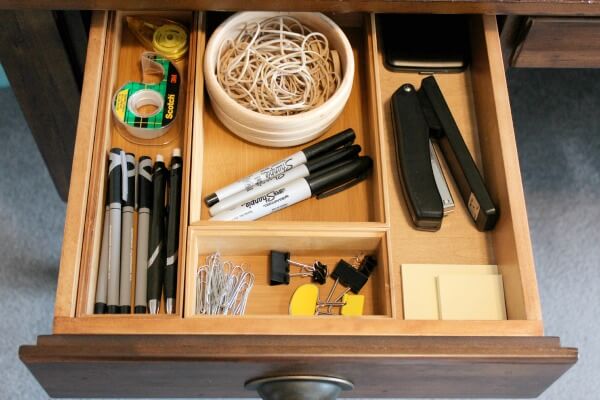
The top drawer is prime real estate — reserve it for the small, frequent things: pens that work, sticky notes, charger, scissors, the one good USB drive. A shallow tray or divider insert here repays itself daily.
4. Dedicate a drawer to large items
Notebooks, headphones, the label maker, backup keyboard — bulky items get one deep drawer of their own so they stop crushing the small stuff.
5. Fill in a step-wise fashion
Work top to bottom: frequency of use maps to drawer height. By the bottom drawer you should be storing things you touch monthly, not daily.
6. Keep like with like
Drawer dividers, cutlery trays, even repurposed small boxes — compartments are what separate “organized” from “one layer of tidy over chaos.” Cables get ties or bags; loose batteries get a container; nothing swims free.
7. Don’t fear empty space
An empty half-drawer isn’t failure — it’s capacity. Resist the urge to fill it; future-you will bring new items soon enough.
8. Label
Labels feel bureaucratic and work anyway — especially on shared desks and for the return-it-where-it-lives habit that keeps the system alive. A cheap label maker or masking tape both do the job.
9. Set up a file-folder drawer
One drawer with hanging rails turns loose paper into a system: active projects up front, reference behind, archive elsewhere. If your desk lacks a file-depth drawer, a small mobile pedestal fills the role — our filing cabinet guide keeps verified picks, and the under-desk drawer units we compared in Jarvis vs UPLIFT desk drawers suit standing desks that came with none.
10. Organize the rest by function
One drawer per job — supplies, tech, paper, personal — so retrieval never requires memory, just logic. Then the maintenance habit: a two-minute reset each Friday, returning strays to their compartments. Ten steps once, two minutes weekly; that’s the entire secret of drawers that stay organized at all times.
Last updated: August 23, 2026 — full 2026 refresh: method condensed to ten steps, filing and under-desk drawer resources linked, original photography retained.