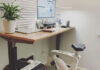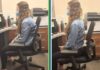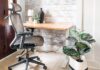

Standing at your desk isn’t exercise — it’s an opportunity for it. The routine below turns that opportunity into ten simple moves in three blocks: strength (claps, calf raises, lateral leg raises), balance (single-leg stands, arm circles, tree pose), and mobility (head rotations, leg extensions, hamstring and quad stretches). Every move works in office clothes, needs zero equipment, and takes under a minute — the point is not a workout, it’s breaking up stillness with “movement snacks” through the day, which is where the research says most of the health value of a standing desk actually lives. Full evidence picture in our Benefits of Standing Desks (2026): What the Evidence Actually Shows.
Strength moves at the standing desk
1. Overhead claps
Stand tall, arms at your sides, and clap your hands together overhead with straight-ish arms, then return — like a standing jumping jack without the jump. Twenty reps wakes up the shoulders and upper back that hunch toward a keyboard all day, and it raises your heart rate just enough to count as a real break. Keep the pace brisk but the shoulders down away from your ears.
2. Calf raises
Feet hip-width, rise onto the balls of your feet, pause a beat at the top, lower with control. Fifteen to twenty slow reps, fingertips on the desk for balance if needed. Calves are the body’s “second heart” for circulation in the lower legs — exactly the system standing all day taxes — and this is the single most desk-compatible strength move there is. Doing them barefoot on a cushioned mat adds a stability challenge; our The 5 Best Standing Desk Mats (2026): Re-Verified Picks guide covers the surface side.
3. Lateral leg raises
One hand on the desk, lift one straight leg out to the side as far as comfortable, lower with control; ten to fifteen per side. This hits the hip abductors and glutes that switch off during both sitting and passive standing, and strong hips are the quiet fix behind a lot of standing-desk lower-back complaints. Keep the torso upright — no leaning into the lift.
Balance moves for steadier standing
4. Single-leg stand
Shift your weight to one foot and hover the other just off the floor for twenty to thirty seconds per side — hand near the desk for safety. It trains the ankle and hip stabilizers that make long standing blocks feel effortless instead of achy, and it doubles as a break for whichever foot has been carrying you. Progress by closing the support hand into a hover, not by closing your eyes at a desk full of coffee.
5. Arm circles
Arms out at shoulder height, draw small circles growing to large, ten forward and ten back. Simple, but it mobilizes the shoulder girdle through ranges a mouse hand never visits, and paired with the single-leg stand it becomes a light coordination drill. If your shoulders click and grind at first, smaller circles and more of them.
6. Tree pose
The yoga classic, office edition: weight on one leg, other foot resting against the standing ankle or calf (skip the knee), palms together at the chest, thirty seconds per side. It stacks posture, balance, and a moment of actually not looking at the screen — the closest thing this list has to a reset button. Desk-adjacent, socks are fine; heels are not.
Mobility and stretch moves
7. Side-to-side head rotations
Slowly turn your head to look over one shoulder, hold two breaths, return through center, repeat the other way — five per side, no forcing, no full circles. Screen work parks the neck in one position for hours; this is the antidote, and it’s the move to do the moment you notice that end-of-day neck tightness starting at 2 p.m.
8. Standing leg extensions
Hand on the desk, extend one leg straight out behind you a comfortable few inches off the floor, squeezing the glute, then return — ten per side. It counteracts the hip-flexor shortening that sitting builds and passive standing doesn’t fix, and it’s subtle enough for an open-plan office. Keep the lower back neutral; the lift comes from the hip, not the spine.
9. Standing hamstring stretch
Prop one heel on a low support (a closed drawer, a sturdy footrest), soften the standing knee, and hinge gently forward from the hips until the back of the propped thigh registers — twenty to thirty seconds per side. Tight hamstrings drag the pelvis into the flat-back slump that makes both sitting and standing ache; this is the highest-value thirty seconds on the list for most desk workers.
10. Quad stretch
Hand on the desk, catch your ankle behind you, knees together, gentle pull until the front of the thigh stretches — twenty to thirty seconds per side. It closes the loop with the hamstring stretch, undoing the front-of-thigh tightness from sitting blocks. Can’t reach the ankle comfortably? Rest the foot on a chair behind you instead — same stretch, no balancing act.
Making it stick
The routine only works attached to triggers you already have: sit-to-stand transitions (our Best Standing Desks of 2026: WFHWorld’s Tested Picks From $250 to $1,000 picks all have memory presets that make the switch one press), the top of each hour, or the end of every video call. Two moves per trigger beats ten moves once a week. Standing on a contoured mat like the Ergodriven Topo keeps the feet fidgeting between sets, and desk workers who want a cardio layer under the routine should look at our under-desk elliptical guide. None of this replaces real exercise — it makes the eight hours between workouts stop working against you.
Last updated: August 22, 2026 — full 2026 refresh: routine reorganized into strength, balance, and mobility blocks with form cues and rep ranges, movement-snack framing aligned with the current evidence, internal guides updated throughout.