
Standing desks have one chronic accessory problem: the keyboard tray. Crossbars under many desks block regular trays entirely, and the trays that do fit are often flimsy. Humanscale’s modular tray systems remain the premium answer in 2026 — this review, re-verified against the brand’s current lineup, covers how the system works, the four models worth knowing, and the installation reality nobody warns you about.
- Top 7 Best Keyboard Trays for Standing Desk [Update 2026]
- Why you should use adjustable keyboard tray under the desk?
Can we expect the same quality?
Humanscale is the brand behind some of the most distinctive ergonomics in the business — we’ve reviewed the remarkable self-adjusting Freedom chair — and the house style runs through everything: sleek, highly engineered, quietly different from what most people are used to. Cheaper generic trays exist, but the reputable-brand advantage is real here: the trays carry the same materials, craftsmanship, and — crucially — a 15-year warranty that generic trays wouldn’t dare print.
Modular keyboard trays
The system is modular, built to fit almost any standing desk rather than the other way around — a Humanscale desk, an UPLIFT, a Jarvis (now sold through Herman Miller), whatever you own. You assemble the system that fits your desk and your wrists.
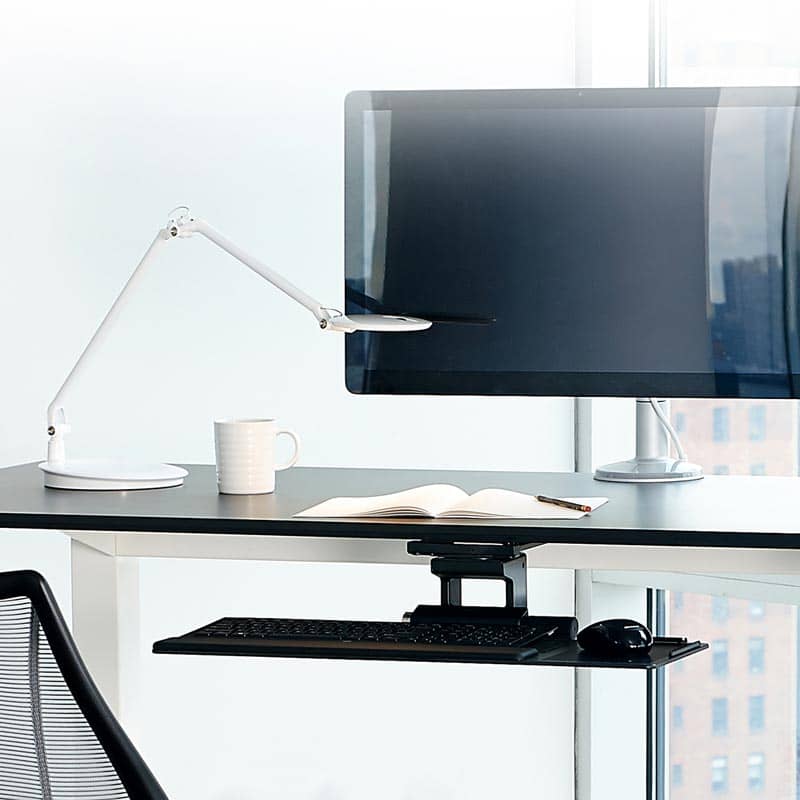
More options for customization
Even at the tray level, Humanscale gives you ways to tune comfort: height adjustment, positive tilt, negative tilt (the wrist-saver most cheap trays skip), and several mechanism types depending on how high and how far from the desk you want the keyboard to ride. A built-in angle readout shows the tilt you’ve set, so once you find your comfortable angle you can return to it without trial and error — in sitting or standing.
Installing one can be a challenge
Honesty first: installing any under-desk tray system challenges the mechanically disinclined, and Humanscale’s — though well documented — is no exception. Knowing the four components makes it manageable.
The track mounts under the desk (pre-drilled screw holes help), in sizes from 11 to 27 inches — a standard keyboard wants roughly 22–25. The red tape at the track’s center is a positioning guide: stick it to the desk’s underside and you can screw the track in without recruiting a second pair of hands.
The mechanism slides into the track and controls everything — height, tilt, angle, and how far the keyboard pulls toward or pushes away from you. Built-in cable management keeps the added hardware from adding visual mess.
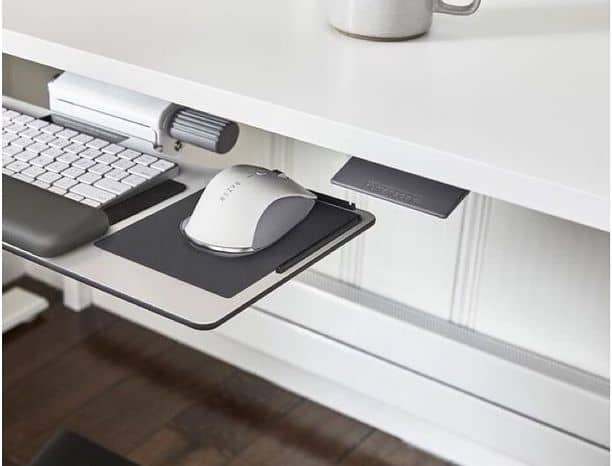
The platform holds the keyboard — Humanscale offers about ten shapes, so finding your fit is a matter of choosing, not compromising. The mouse platform attaches to rails on either side and slides independently — pull the mouse close, push it away when it crowds the keyboard. Heavenly for wrists.
And speaking of wrists: if carpal tunnel is part of your story, the optional palm rest — gel or foam, wrapped in fabric or leather, running the tray’s full width — is the box worth ticking.
Popular Humanscale keyboard tray systems
The 900 Keyboard tray system
The universal model, sized for most keyboards, with your choice of swivel or clip-on platform. It’s steady and durable while running thinner than generic trays — premium that means serious business. The honest gripe: aligning the mouse tray with the keyboard tray took us real time. Once set, the glide in and out is a pleasure and the mouse pad pivots to a comfortable level with the keyboard.
500 Keyboard tray
The bigger, wider option for larger keyboards — wide enough that the mouse fits on the tray itself, no separate mouse platform needed.
100 Keyboard tray
The “combination” tray with a sloped front edge, built to pair with keyboards that carry a sloped front of their own.
Floating keyboard tray
Our favorite. Same premium materials, decent customization — but compact and sleek, clipping to the desk’s underside with no long track to install, floating there as the name promises. It resembles iMovR’s trackless tray in concept. The trade-offs: the mouse pad doesn’t adjust independently of the keyboard (the 900/500/100 win there), the height isn’t adjustable (your standing desk provides that), and the tilt reaches 15 degrees rather than the 20 an iMovR Stowaway manages. If you value sophistication over maximum adjustment, this is the one.
Final Say
A proper keyboard tray is a gift your wrists cash in daily, and generic trays — flimsy, saggy — aren’t worth the savings. Humanscale’s systems are the category’s quality benchmark: the tracked models (900, 500, 100) for maximum customization with less bulk than cheaper trays, the Floating tray for minimalist installs, and every one of them backed by that 15-year warranty. They sell direct at humanscale.com and through office dealers; our keyboard tray roundup shows how they stack against the rest of the field.
Last updated: August 30, 2026 — full 2026 refresh: lineup re-verified against the brand catalog, Jarvis reference updated to the HM era.