
The blunt version, 2026 edition: the RTX 4090 was its generation’s raw-power champion and the RTX 4080 the card most people should have bought — and now that the 50-series owns the shelves, both are discontinued, deal-market cards. Buy either only at a genuine discount from current prices: a used 4090 still monsters 4K, a discounted 4080 is still a superb 1440p-and-4K card, but at anywhere near new-card money the RTX 5080 — with DLSS 4 multi-frame generation the 40-series will never get — is the better purchase.
Nvidia launched the RTX 40 series in October 2022, and its two premium cards — the RTX 4080 and RTX 4090 — spent two years as the benchmark pair for 3D rendering, video editing and 4K gaming. In 2026 the question this page answers has changed shape: nobody is choosing between them at full retail anymore, because neither sells at full retail. The choice now is between a discounted or used 4080, a discounted or used 4090, and simply buying current-generation instead. The comparison below still matters — it decides which side of the used market is worth your money.
- The Best Affordable Gaming Laptops From $1,000 (2026)
- The 7 Best Budget-Friendly Gaming Laptops of 2026
Power draw and the connector question
The two cards are rated a full power class apart: 450 watts TDP for the RTX 4090 against 320 watts for the RTX 4080. In practice that means the 4090 wants a serious power supply — 850W is the sensible floor — and better case airflow, while a 4080 drops into far more ordinary builds. The 4090’s 12VHPWR connector also earned its scars: early adopters documented melted adapters, almost always traced to connectors that were not fully seated. The revised 12V-2×6 connector and years of cable maturity have largely closed the issue, but it is the one thing to inspect first when buying a used 4090 — ask for photos of the connector before paying.
Gaming Performance
The performance gap between the two is consistent and well documented. In matched 4K test systems, Assassin’s Creed Valhalla averages around 115 frames per second on the 4090 against 93 on the 4080; God of War runs about 132 to 96; Horizon Zero Dawn about 110 to 83. The gap narrows exactly where you would expect: in CPU-bound scenarios like Marvel’s Spider-Man Remastered with ray tracing, the two cards land roughly a dozen frames apart, because the processor — not the GPU — sets the ceiling. The rule of thumb that emerges: the 4090 is roughly 20-30% faster where the GPU is the bottleneck, for 40% more power draw, and it remains the only 40-series card that treats native 4K maximum-settings gaming as routine.
The other number that matters more in 2026 than it did at launch: memory. The 4090 carries 24GB of VRAM to the 4080’s 16GB, and both figures age differently now — 16GB is comfortable for 4K gaming today, while the 24GB card doubles as a serious tool for local AI workloads and heavy 3D scenes, which is precisely why used 4090 prices refuse to fall the way old flagships usually do.
Price in the 50-series era
Both cards are out of production, so “price” now means the used and clearance market, and it behaves oddly: the 4090’s AI usefulness props its used prices up near where upper-current-generation cards sell new, while 4080s and 4080 Supers drift down into genuinely interesting territory. That inversion writes the 2026 buying advice by itself. A fairly priced used 4080 is the sleeper deal of the generation for a 1440p or 4K gamer. A used 4090 only makes sense if you specifically want its 24GB for work as well as play — as a pure gaming purchase, its price usually argues you into a new RTX 5080 instead, which brings DLSS 4 multi-frame generation, lower power draw, and a warranty.
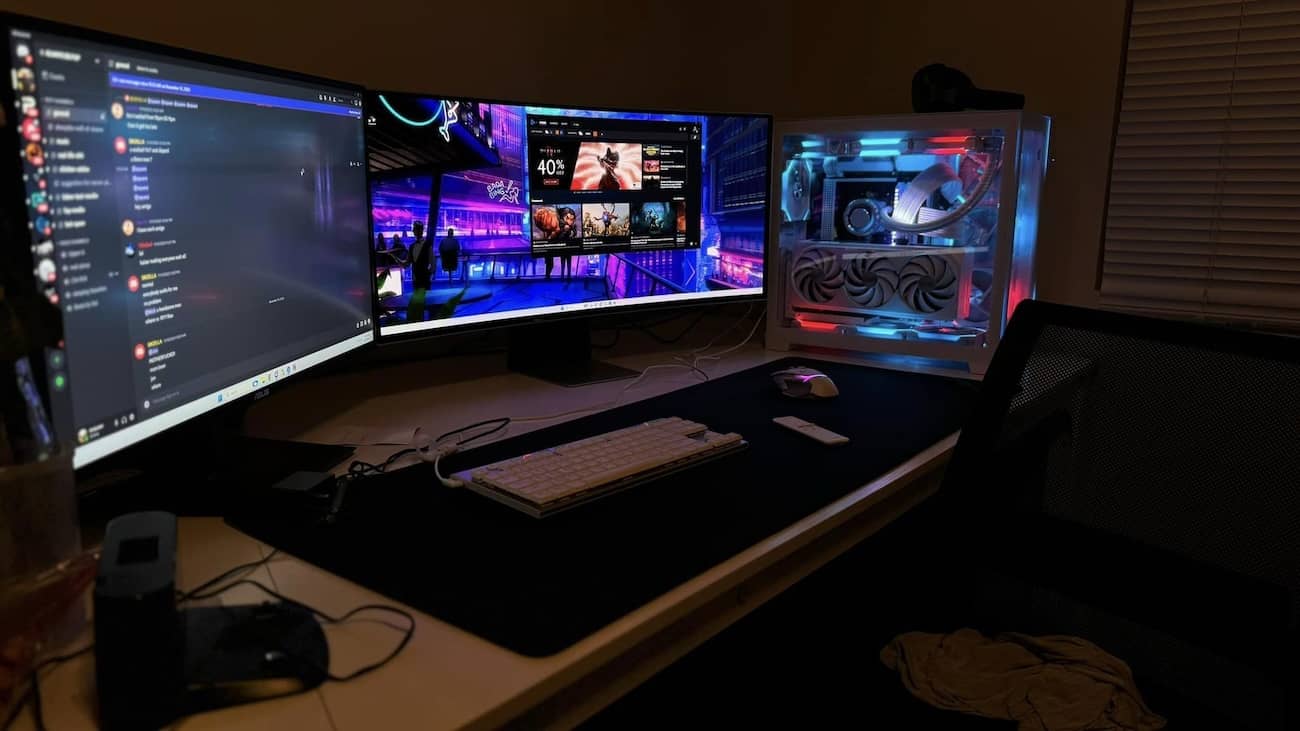
So the verdict holds its old shape with new numbers around it. Starting a top-end build from scratch in 2026, you buy current generation — the 50-series took the crown and the shelf space. Upgrading from any 40-series card to another 40-series card remains the move this page has always advised against: the uplift never justified the cost, and it justifies it even less used-to-used. But as a value hunt, the pecking order is clear: discounted 4080 first for gamers, used 4090 only for the 24GB crowd, and the current-generation card whenever the price gap closes to a few hundred dollars.
The details of the comparison are in the table below.
| GPU | TDP | VRAM | Gaming Performance in FPS (All in 4K) | ||||
| Assassin’s Creed Valhalla | God of War | Horizon Zero Dawn | Spider-Man Remastered | ||||
| RTX 4080 | 320 Watt | 16GB | 93 | 96 | 83 | 86 | |
| RTX 4090 | 450 Watt | 24GB | 115 | 132 | 110 | 98 | |
- The 10 best 1440p 144hz Monitors for Gaming + Buyer’s Guide
- The 7 best 4k Gaming Monitors for Stunning Visuals and High-Performance
Last updated: August 16, 2026 — rewrote the comparison for the 50-series era: used-market buying advice, corrected TDP figures, added VRAM to the comparison, fixed a swapped results table from the previous version, and refreshed the verdict and internal links.