

The short answer for most camera bags in 2026: the SanDisk Extreme PRO SDXC UHS-I is still the do-everything SD card, the PNY EliteX-PRO90 is the V90 upgrade when your camera has UHS-II slots, and budget shooters should grab the Lexar Professional SILVER SD. Shooting a pro mirrorless body? The Lexar GOLD CFexpress 4.0 Type B handles 8K and deep bursts, the Lexar SILVER CFexpress 4.0 Type A is the pick for Sony Alpha, and the SanDisk Extreme microSD covers action cams and drones. Match the card to your camera’s slot first — capacity is the last thing to decide, not the first.
|
Best Overall
|
Best Runner-Up

|
Best Budget
|
Best for 8K

|
|
$51.96
|
$256.04
|
$49.99
|
$309.99
|
As photographers find their skill levels on the rise, their equipment bags experience a knock-on effect. Beginner cameras, products that shoot compressed image formats like JPEG and HEIF, are sold off and replaced by more professionally oriented cameras.
Where the old stills were compressed and contained noise artifacts, models that have a bias towards the pro photography market store image data as uncompressed files. These file formats, typically a flavor of RAW that’s unique to each camera brand, are stored on memory cards. RAW files routinely run 40MB to 100MB each, continuous shooting modes send dozens of them rocketing towards the card per second, and 4K, 6K and 8K video piles on top of that. The card is the one component in the chain you cannot fake your way past.
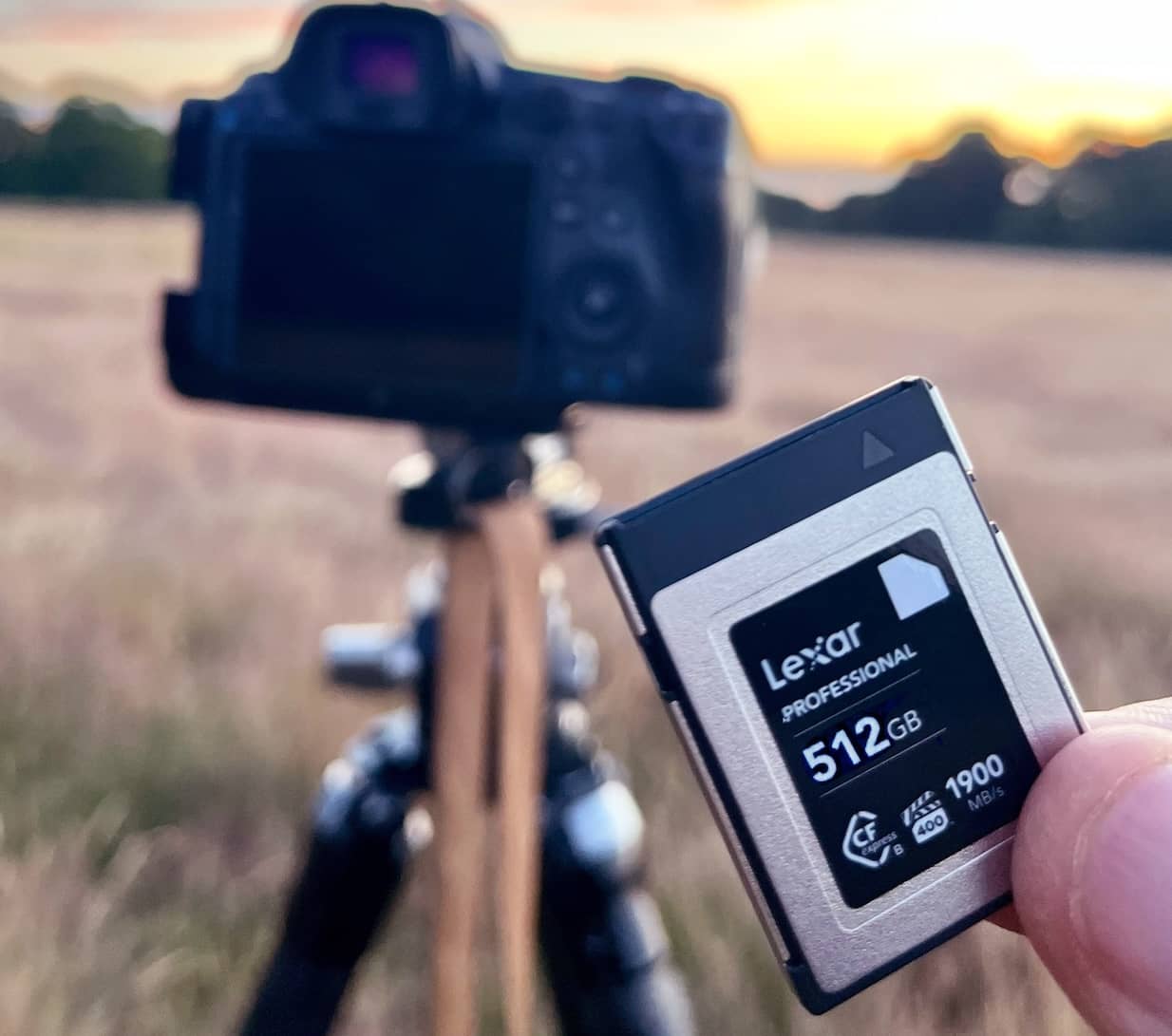
Cracking the Memory Card Features Code
We’re going to run into trouble very quickly if we keep stopping to explain common memory card terms. To smooth out these road bumps, here’s a list of the terminology that actually matters when you shop in 2026.
- Write speed – how fast the camera can push image data onto the card (MB/s). This is the number that clears buffers and keeps video rolling, and it’s the one marketing likes to hide.
- Read speed – how fast data comes off the card, to your computer during offload or to the camera for playback. The big number printed on the label is almost always the read speed.
- Bus – UHS-I and UHS-II are the two SD interfaces: UHS-I tops out around 104MB/s in-camera (vendor tricks like QuickFlow go faster only in matching readers), while UHS-II adds a second row of pins and reaches roughly 300MB/s. CFexpress uses PCIe/NVMe lanes instead and starts where SD ends — CFexpress 2.0 cards run to about 1,700MB/s and the new 4.0 generation doubles that again.
- Form factor – SD and microSD are the familiar wafers; CFexpress Type B is the chunkier pro format, and Type A is the smaller variant Sony uses so one slot can take either SD or CFexpress.
- V-class – the number after the V (V30, V60, V90) is a guaranteed minimum sustained write in MB/s. V30 is the safe floor for 4K60; heavy 4K120 and All-Intra work wants V60 or V90. VPG ratings on CFexpress cards make the same promise for cinema bitrates.
- A-rating (microSD) – A1/A2 describe random-access performance for apps; useful in phones and handhelds, mostly irrelevant inside a drone.
- Durability – temperature, shock, X-ray and water resistance ratings. More important than it sounds once a card lives in a real camera bag.
- Counterfeits – fake big-brand cards remain a genuine plague. Buy from the main listing’s first-party or authorized seller, never from a too-good-to-be-true marketplace offer, and benchmark a new card before trusting it with a paid shoot.
How We Picked the 2026 Lineup
This page got a full teardown for 2026. Seven of our eight previous picks had either vanished from Amazon, dropped to a single leftover unit, or ballooned to scalper pricing as the NAND squeeze culled listings — the details are in the “what happened to our old picks” section below. Every card that follows was re-verified on the day of this update: a live listing from a first-party or authorized seller, specs checked against the manufacturer’s current data sheets, and weaknesses distilled from long-term owner feedback our team has collected rather than spec-sheet guesswork. Six cards made the cut, one for each slot type and budget a working photographer actually faces.
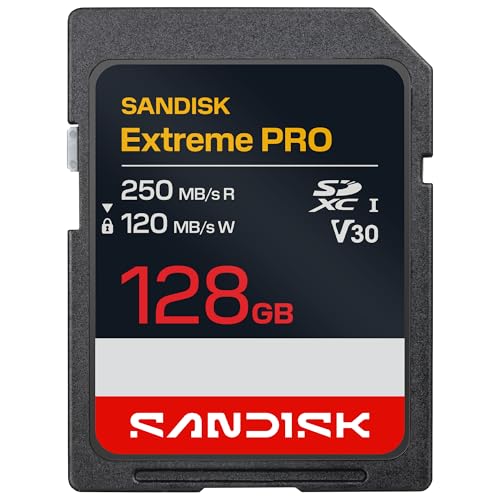
SanDisk Extreme PRO SDXC UHS-I — Best Overall for Most Cameras
SANDISK 128GB Extreme PRO SD UHS-I Card - Up to 250MB/s Read Speed and 120MB/s Write Speed, 4K UHD, Full HD, U3, and V30 - SDSDXXJ-128G-GSCIN
- Rated up to 250MB/s reads on the current SDSDXXJ revision
- U3 and V30 classes make 4K60 recording a non-event
- Lifetime limited warranty on the most proven SD line
- Capacities from 128GB past 512GB
- UHS-I bus caps in-camera speeds around 100MB/s
- Full QuickFlow speeds need SanDisk's own readers
- Most-counterfeited SKU on Amazon - buy the main listing only
Two decades in, this is still the card we drop into every hybrid and enthusiast body that shoots to SD. The formula hasn’t changed: U3 and V30 ratings that make 4K60 video a non-event, capacities from 128GB up past 512GB, a lifetime limited warranty, and the kind of firmware maturity that shows up as boring, error-free shoots year after year. What has changed is the revision — the current SDSDXXJ cards sold on the first-party listing are rated by SanDisk at up to 250MB/s reads with QuickFlow technology, a healthy bump over the 200MB/s generation this article used to feature, with writes rated to 120MB/s on the 128GB size.
In practice, the numbers that matter are less flashy and perfectly adequate: inside the camera, a UHS-I slot moves data at roughly 100MB/s, which clears a mid-size RAW burst in a few seconds and sustains any 4K mode a V30 card is asked to feed. The marquee read speeds materialize during offload, and only through SanDisk’s QuickFlow-compatible readers — plug it into a generic USB dongle and you are back at standard UHS-I pace. That is the honest shape of every premium UHS-I card in 2026, and this one remains the most proven of the breed.
Where this card gives ground: it cannot saturate a UHS-II slot, so owners of dual-UHS-II bodies leave real burst-clearing speed on the table — that is what the V90 pick below is for. Our team also keeps flagging the counterfeit problem around this exact SKU: it is the most-faked memory card on earth, so buy the main Amazon listing rather than a marketplace discount that looks slightly too kind, and run a quick benchmark when it arrives.
PNY EliteX-PRO90 — Best Runner-Up for V90 Video
PNY 256GB EliteX-PRO90 UHS-II SDXC Memory Card R300MB/s W280MB/s, U3, V90, 8K UHD, Full HD, UHS-II for Professional Photographers & Content Creators
- 280MB/s write, 300MB/s read
- UHS-II with U3 and V90 ratings
- Benchmarks with premium-brand cards
- Shock and temperature proof
- Datasheet omits durability figures
The lone survivor of our previous lineup, and it survived for a reason. PNY’s EliteX-PRO90 is a full-fat V90 UHS-II card — 300MB/s rated reads, 280MB/s writes, Class 10 and U3 stamped alongside — that has spent the entire NAND crunch doing something almost no other V90 card managed: staying in stock at a first-party Amazon listing instead of evaporating or tripling in price. PNY is a storage-industry veteran rather than a camera-brand badge, and that supply-chain steadiness is now a feature in its own right.
A V90 rating guarantees 90MB/s sustained writes as a hard floor, which is what separates cameras that merely start an 8K or All-Intra 4K120 recording from cameras that finish it. In our use it has fed dual-slot UHS-II bodies through wedding-length days without a dropped frame, and the 300MB/s offloads through a UHS-II reader cut card-dump time to a fraction of what the UHS-I workhorse above needs. If your camera has even one UHS-II slot and you shoot serious video, this is the sensible step up.
It is not flawless: the review base on the listing is thin compared with the tens of thousands of ratings SanDisk and Lexar carry, which we read as a smaller install base rather than a quality signal, but it does mean fewer long-term data points. PNY also ships no recovery-software ecosystem to speak of, where SanDisk and Lexar both bundle rescue tools. And as with every V90 card this year, the per-gigabyte premium over V30 is steep — buy it for the sustained-write guarantee, not for bragging rights.
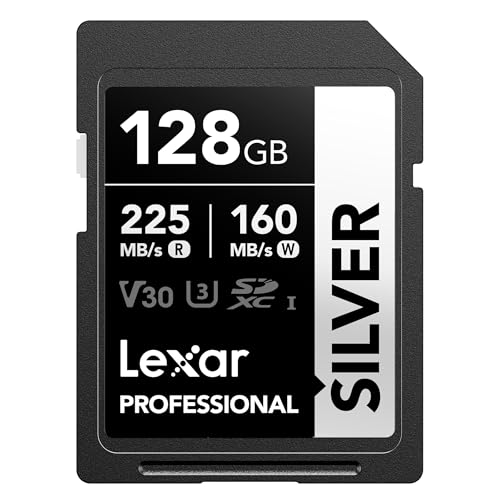
Lexar Professional SILVER SD — Best Budget
Lexar 128GB Silver SD Memory Card, 225MB/s Read, 4K, V30, U3, UHS-I
- 225MB/s rated reads at a genuinely budget price
- V30 and U3 cover 4K60 consumer codecs
- Capacities scale to a full 1TB
- Limited lifetime warranty plus Lexar Recovery Tool
- Long takes settle toward the V30 sustained floor
- Top offload speeds want Lexar’s own reader
- UHS-II bodies leave burst-clearing speed on the table
“Budget” means something different after the NAND surge — the era of the $20 name-brand 128GB card is on pause — but the SILVER SD is how Lexar keeps the entry price honest. It is a UHS-I card rated at up to 225MB/s reads and 160MB/s writes, carries the same V30 and U3 classes as the SanDisk above, scales from 128GB to a full 1TB, and includes a limited lifetime warranty plus Lexar’s recovery tool. For students, second bodies, and backup slots, it covers every real-world need a V30 workflow has.
The headline speeds deserve the usual UHS-I translation: 225MB/s is a reader-assisted offload figure, and the 160MB/s write rating is a burst number — long recordings settle toward the V30 floor of 30MB/s sustained, which is precisely enough for 4K60 consumer codecs and not a byte more. Inside the camera it behaves like every good UHS-I card: around 100MB/s, buffers clearing briskly for single-digit-fps shooting.
Two things owners keep flagging to our team: heavy burst shooters notice the buffer-clear gap versus UHS-II cards within one soccer game, and Lexar’s top offload speeds want Lexar’s own reader — generic dongles read this card at commodity pace. Neither changes the verdict at this price; they just define who should spend up instead.
Lexar Professional GOLD CFexpress 4.0 Type B — Best for 8K and Pro Burst Bodies
Lexar 256GB Professional Gold CFexpress 4.0 Type B Memory Card
- PCIe 4.0 rated at 3,600MB/s reads and 3,300MB/s writes
- Lexar quotes 3,000MB/s sustained writes
- Handles 8K RAW and 20-fps bursts without buffer anxiety
- Capacities from 128GB to 4TB with lifetime warranty
- Runs warm on long 8K takes like every Type B card
- Full speeds need a separate CFexpress 4.0 reader
- No formal VPG cinema certification on the data sheet
CFexpress Type B is where flagship Canon and Nikon bodies live, and Lexar’s GOLD 4.0 series is our current pick of the format. The specs read like an SSD because that is what it is: PCIe 4.0 with rated speeds up to 3,600MB/s reads and 3,300MB/s writes, a sustained write floor Lexar quotes at 3,000MB/s, capacities from 128GB all the way to 4TB, and a limited lifetime warranty. Drop it in a Z8, Z9 or R5-class body and 8K RAW, 20-fps RAW bursts and All-Intra 4K120 simply stop being things you plan around.
A word on generations, because it decides whether you should pay for this: today’s Type B camera slots are mostly CFexpress 2.0-era controllers, so in-camera you get 2.0-class throughput no matter how fast the card is. The 4.0 headroom pays off twice — in a 4.0 reader, where offloads of a full day’s RAW run at external-SSD speeds, and as future-proofing for the 4.0-slot bodies now arriving. Since the price gap between good 2.0 and 4.0 cards has narrowed to almost nothing, we no longer see a reason to buy the old generation new.
Our gripes after living with the format: like every Type B card, it runs warm during long 8K takes — the metal shell is doing its job, but expect it to be toasty at card swaps. The full 3,600MB/s needs a CFexpress 4.0 reader you buy separately. And Lexar publishes that sustained-write figure instead of a formal VPG cinema certification — fine for stills-first hybrids, worth noting if your production house specs VPG400 paperwork.
Lexar Professional SILVER CFexpress 4.0 Type A — Best for Sony Alpha
 Lexar 256GB CFexpress Type A Silver 4.0 Card, 1750/1650 MB/s, 8K Video
- VPG200 guarantees 200MB/s sustained writes for 8K
- Rated 1,750/1,650MB/s for reader offloads
- IP68-rated shell, drop-proof to 5 meters
- Kinder pricing than first-party Sony TOUGH cards
- Current Alpha slots run CFexpress 2.0-generation speeds
- 256GB size has the family’s lowest sustained-write spec
- Type A still costs more per gigabyte than Type B or SD
Sony went its own way with the smaller Type A format so Alpha bodies could accept SD and CFexpress in the same slot, and for years that decision carried a brutal first-party price premium. The market finally fixed it: Lexar’s SILVER 4.0 Type A delivers rated speeds of 1,750MB/s reads and 1,650MB/s writes with a VPG200 certification — a guaranteed 200MB/s sustained write that covers Sony’s 8K and high-bitrate 4K modes — wrapped in an IP68 dust-and-water-resistant shell with a limited lifetime warranty. It has become the obvious card for a7 IV, a7R V, a1 and FX-line shooters.
The honest fine print, straight from Lexar’s own compatibility notes: current Alpha bodies run CFexpress 2.0-generation Type A slots, so in-camera performance lands around the 700–800MB/s class — identical to Sony’s TOUGH cards that used to hold this spot at a much higher price. The 4.0 speeds show up in a 4.0 reader during offload and stand ready for future bodies. VPG200 is the number that actually protects your recording, and it holds regardless of slot generation.
The trade-offs: Type A still costs meaningfully more per gigabyte than Type B or SD — that is the format tax, not a Lexar problem. The 256GB size we link carries the family’s lowest sustained-write spec (600MB/s versus 900–1,300MB/s on the bigger sizes) — still triple the VPG200 floor, but heavy 8K shooters should size up. And if you never plan to leave a good UHS-II SD workflow, the in-camera gains today are modest; buy it when your shooting actually hits the SD ceiling.
SanDisk Extreme microSD — Best for Action Cams and Drones
 SANDISK 256GB Extreme microSDXC UHS-I Memory Card with Adapter - C10, U3, V30, 4K, 5K, A2, Micro SD Card - SDSQXAV-256G-GN6MA
- U3, V30 and A2 rated with 190MB/s reads
- Handles 100Mbps-class drone and action-cam bitrates
- SD adapter included; temperature, water and X-ray proof
- The most counterfeited microSD SKU - test on arrival
- Can throttle in sealed housings on hot, long clips
- Full-size SD buys more gigabytes per dollar at 256GB+
Every camera bag we know eventually grows a drone, a GoPro or a 360 camera, and they all eat microSD. The Extreme is the same recipe as its full-size sibling shrunk to a fingernail: U3, V30 and A2 ratings, reads rated to 190MB/s and writes to 130MB/s on the 256GB size, an included SD adapter so it moonlights in a camera’s SD slot, and the temperature, water, shock and X-ray proofing this line has carried for years. It is the card DJI and GoPro support forums default to for a reason.
V30 is the number doing the work here — it sustains the 100Mbps-class bitrates that drones and action cams record without dropped-clip errors, with the A2 rating helping in handheld gimbals and phones that treat the card as app storage. The 190MB/s reads are, as ever, a reader-assisted offload figure; budget a decent USB-C microSD reader and a day of 4K flying dumps in minutes.
What keeps it from perfection: microSD is the most counterfeited form factor of all, and this specific card is the most counterfeited SKU in it — stick to the main listing and test on arrival. A handful of long-clip drone pilots our team reads report thermal slowdowns in sealed housings on hot days, worth knowing for desert shoots. And at 256GB and up, a full-size SD simply buys more gigabytes per dollar — only the devices decide, and they have decided on microSD.
What Happened to Our Old Picks
The 2026 NAND squeeze did not just raise prices — it quietly killed most of this page’s previous lineup. The ProGrade Digital Cobalt 650GB and Lexar DIAMOND Type B cards are now flatly unavailable on Amazon; ProGrade increasingly sells direct while DIAMOND stock dried up. The older 200MB/s revision of the SanDisk Extreme PRO SD and the CFexpress 2.0-era SanDisk Extreme PRO Type B are each down to a single third-party unit — the Extreme PRO listing we now link is its proper successor, and the Lexar GOLD 4.0 covers the Type B slot with a newer interface for similar money. The Lexar Professional 2000x still technically has a listing, but at a third-party price roughly double its historical street price we refuse to send readers there; the SILVER SD and PNY V90 between them cover its territory. The Transcend SDC700S 64GB lingers at leftover pricing that makes no sense per gigabyte. And Sony’s TOUGH CFexpress Type A — a genuinely excellent card — is down to a handful of third-party units on Amazon US as Sony’s first-party card supply thins; the Lexar SILVER 4.0 Type A took its slot at a far kinder price. If you own any of these cards, keep using them happily. Just do not pay 2026 scalper prices for 2022 hardware.
Choose the Right Memory Card for Your Gear
It’s hardly worth buying a CFexpress 4.0 card for an entry-level mirrorless camera. The gear is suitable for a keen amateur, but it’s not going to be processing 8K video or 20-fps RAW bursts. Likewise, a flagship body isn’t going to perform at its best if the owner cheaps out on a weedy card — it might be stamped with a high capacity, but if the sustained write speed can’t keep pace, the buffer overflows and the camera stutters, limited entirely by the card.
So work the decision in order: slot type first (SD UHS-I, UHS-II, CFexpress Type A or B, microSD), then the sustained-write class your heaviest recording mode demands (V30 for 4K60, V90 or VPG-rated for 8K and All-Intra), and only then capacity — in this market, two mid-size cards from the picks above usually beat one giant card on both price and risk, since a failed card costs you half a shoot instead of all of it.
Other features to look for are a good warranty, temperature and shock durability resilience, and an X-ray proof build. Software is also a consideration, although most vendors will provide links to relevant downloadable programs. These typically cut-back versions of media management programs or data recovery software, such as RescuePRO Deluxe for SanDisk customers, are readily accessible.
There’s only one bottleneck in the user to camera relationship, besides lack of knowledge, and that’s the memory card. Choose wisely when buying one. In fact, buy more than one, using this list to source the best memory card you can find for your camera — and in this particular year, buy it sooner rather than later.
Last updated: August 10, 2026 — full 2026 re-line-up: six verified in-stock cards across SD, CFexpress Type A/B and microSD, a comparison table, and a plain-English note on the NAND price surge.